What is Principles First Thinking?
My prayer: May this idea give you the courage to question the rules everyone else blindly follows.
Many industries are built on dumb assumptions that nobody questions.
The coaching and course industries are no different.
Entire industries can operate for decades inside invisible mental cages built from inherited beliefs, outdated processes, and unchallenged dogma.
The most innovative entrepreneurs in the world understand something different.
They know that many of those assumptions collapse the moment you examine them closely.
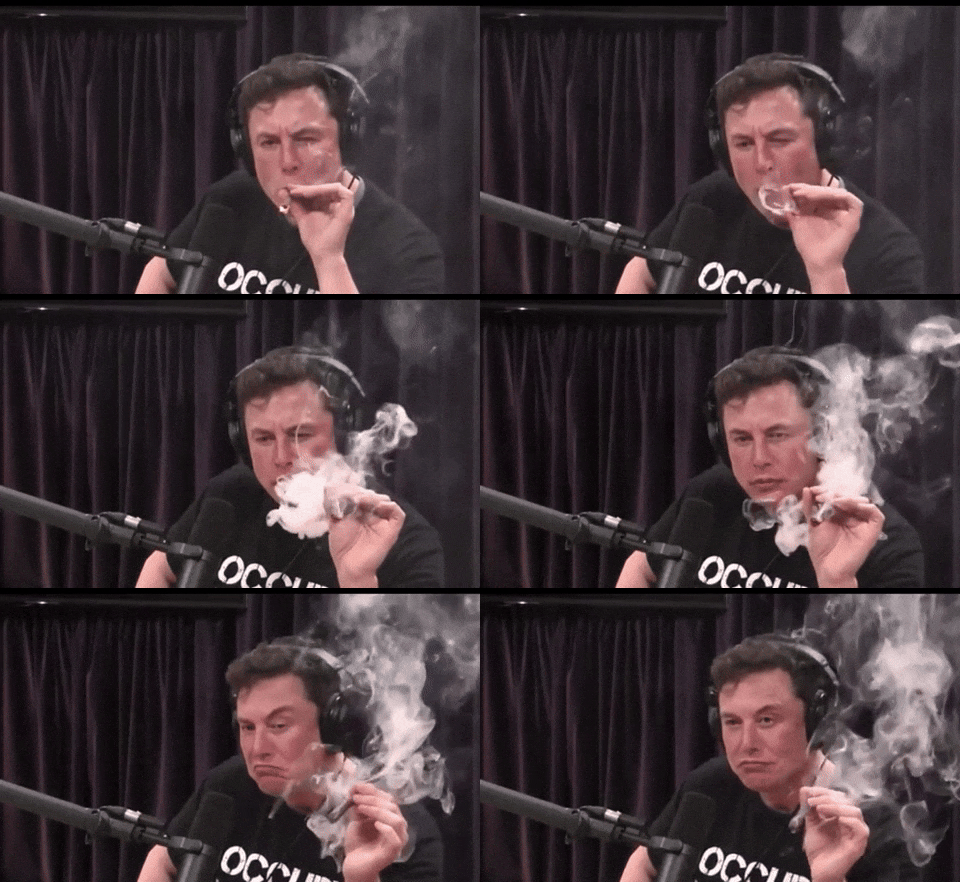
One of the clearest examples of this is how Elon Musk approached the problem of building rockets (love this story).
The Rocket Cost Problem
When Musk started SpaceX, he encountered a massive obstacle.
Rockets were extremely expensive.
The aerospace industry treated this as an "unavoidable reality". Launching rockets simply cost tens of millions of dollars and that's that. Most companies accepted that premise and focused on making small improvements around the edges.
But Musk approached the problem differently. Instead of asking how to make rockets slightly cheaper, he asked a deeper question.
Why the hell are rockets so expensive in the first place?
Breaking the Problem Down to Fundamentals
Musk began examining the rocket expense problem from a first principles perspective.
What is a rocket actually made of?
At its core, a rocket consists of fairly straightforward materials: aluminum alloys, titanium, copper, carbon fiber, and electronic components.
None of those materials are inherently rare or impossibly expensive. When Musk looked at the commodity price of those materials, he discovered something surprising.
The raw materials represented only a tiny percentage of the total cost of a rocket.
The majority of the cost came from legacy aerospace practices: layers of subcontractors, slow development cycles, inefficient manufacturing processes, and deeply entrenched industry assumptions.
The problem wasn’t physics.
It was the system.
Questioning the Biggest Assumption of All
Once Musk understood the system, he began questioning the assumptions embedded inside it.
One of the biggest assumptions in aerospace was that rockets were disposable.
Launch them once.
Then throw them away.
From a first principles perspective, that assumption made very little sense.
Imagine if airplanes worked that way. Seriously, imagine purchasing a Boeing 747, flying it across the ocean once, and then discarding it.
Commercial aviation would be impossibly expensive.
SpaceX asked a simple but radical question.
What if rockets could land and be reused?
Rebuilding the System
That question led to one of the most important breakthroughs in modern aerospace engineering.
SpaceX began designing rockets that could return to Earth and land vertically after launch.
Instead of throwing away the most expensive components, they could refurbish and reuse them.
By eliminating the assumption that rockets "must be" disposable, the economics of space travel changed dramatically.
Launch costs dropped significantly.
And SpaceX quickly became the dominant launch provider in the world.
The breakthrough did not come from incremental improvement.
It came from challenging industry dogma, tearing the entire system to shreds and then rebuilding the system from first principles. Fucking rad.
Challenging Assumptions in Your Own Industry
You don’t need to build rockets to apply first principles thinking.
You can apply this same mental model to your own work.
Start by identifying the assumptions in your industry.
Ask yourself:
What does everyone believe about how this business works?
What “rules” are treated as unquestionable?
Then go deeper.
Are those actually laws of nature?
Or are they simply habits that have been repeated for years?
Once you separate facts from assumptions, new possibilities begin to appear.
Many of the most powerful breakthroughs in business occur when someone challenges a belief that everyone else stopped questioning long ago.
Key Takeaways
- First principles thinking breaks problems down to their most basic truths rather than relying on tradition or analogy.
- Many industries operate on inherited assumptions that may no longer be valid.
- Elon Musk dramatically reduced rocket launch costs by challenging aerospace dogma and redesigning the entire system from the ground up.
- Innovation often begins the moment someone questions a belief that everyone else accepts as obvious.
Reflection Questions
- What assumptions exist in your industry that everyone treats as obvious or unquestionable?
- Which of those assumptions are actually laws of reality and which might simply be inherited habits?
- If you broke your business down to its most fundamental truths, what parts of your current model might look inefficient or unnecessary?
- What is one “rule” in your field that you’ve always followed but never deeply examined?
- If you rebuilt your business from scratch today using first principles thinking, what would you design differently?
Be free, Melynda
Author

Melynda Smith
Author
I help coaches, consultants and course creators create infinitely scalable, lifestyle first, WFA (work from anywhere), profitable businesses.
Categories
All CategoriesRecent Posts
